

Case study
An immersive storytelling experience about the Gir forest and its lions
Project snapshot
- Project
- Supply, Installation, Testing and Commissioning of the Ambardi Safari Park Interpretation Centre
- Location
- Dhari, Amreli District, Gujarat
- Designed & developed by
- M/s Futurotec Solutions Pvt. Ltd.
- Role
- End-to-end — concept, design, content development, supply, installation, testing and commissioning
- Completion date
- 30 March 2024
- Status
- Completed and delivered with satisfactory outcome
The brief
Ambardi Safari Park sits at the edge of the Gir landscape — the last natural home of the Asiatic lion. Visitors arrive curious but largely uninformed: they know they are here to see lions, and little more about the forest that sustains them.
The interpretation centre was commissioned to close that gap. The mandate was to build a set of experiences that could communicate the ecology, seasonality and character of Gir to a general audience — families, school groups, domestic tourists — in a form that holds attention without requiring prior knowledge or long reading.
Four distinct experiences were specified, each addressing a different part of the story and a different mode of engagement: immersion, exploration, narrative, and self-directed discovery.
An educational awareness platform
Beyond visitor engagement, the centre was conceived to function as a permanent educational and conservation awareness platform for the Gir ecosystem. The Asiatic lion survives in one place on earth, and its future depends substantially on whether the public — particularly the next generation — understands the forest as a living system rather than a backdrop for a photograph.
The centre was therefore designed to teach without lecturing:
- Ecological literacy — the Gir forest presented as an interconnected habitat, not merely as lion territory.
- Seasonal understanding — how the landscape transforms across six seasons, and why that cycle governs the survival of every species within it.
- Species awareness — the Asiatic lion’s distinct identity, its status, and the significance of Gir as its sole natural range.
- Conservation values — the case for protection delivered through immersion and narrative, so that it registers emotionally rather than as instruction.
For school groups and student visits in particular, the centre functions as a structured field-learning environment: a complete introduction to Gir that can be absorbed in a single visit, before students ever enter the safari zone.
Scope 1 — 360-degree immersive projection room
Duration: 5 minutes
The centrepiece of the facility. A fully enclosed projection environment that surrounds visitors with the Gir forest.
What was delivered:
- Original story development. A narrative arc about the Gir forest was written specifically for the space — not a documentary voiceover laid over stock footage, but a story structured for a 360-degree canvas where the audience chooses where to look.
- 360-degree drone cinematography of Gir Forest. Aerial capture across the actual landscape, giving the sequence its authenticity. Drone work in a protected forest area demands careful planning around permissions, wildlife disturbance, light conditions and flight windows.
- Full 360-degree visualisation and projection engineering. Content mastered for wraparound projection, with edge blending, warping and calibration across the room geometry so the image reads as a continuous environment rather than a set of adjacent screens.
Why it works: Five minutes is the right length for a walk-through venue. Long enough to establish place and emotion, short enough to keep throughput high on busy days without queue build-up.
Scope 2 — Six seasons on a 98-inch interactive panel
1 minute per season
Gir is not one landscape. It is six, cycling through the year — and that seasonal rhythm governs everything from water availability to lion movement and prey behaviour.
What was delivered:
- Supply and installation of a 98-inch interactive touch panel, sized so that a group can gather around it and multiple visitors can engage at once.
- Microsoft Surface integration as the driving system for the interactive layer.
- 360-degree drone capture of six distinct seasons — six separate shoots across the year, each returning to the same landscape to record how it transforms. This is the most logistically demanding element in the entire project: it cannot be compressed, batched or shot out of sequence.
- Touch-driven interface allowing visitors to select a season and view a one-minute immersive segment.
Why it works: Visitors set their own pace and follow their own curiosity. A one-minute unit per season means someone can sample one or watch all six, and the exhibit adapts to whoever is standing in front of it.
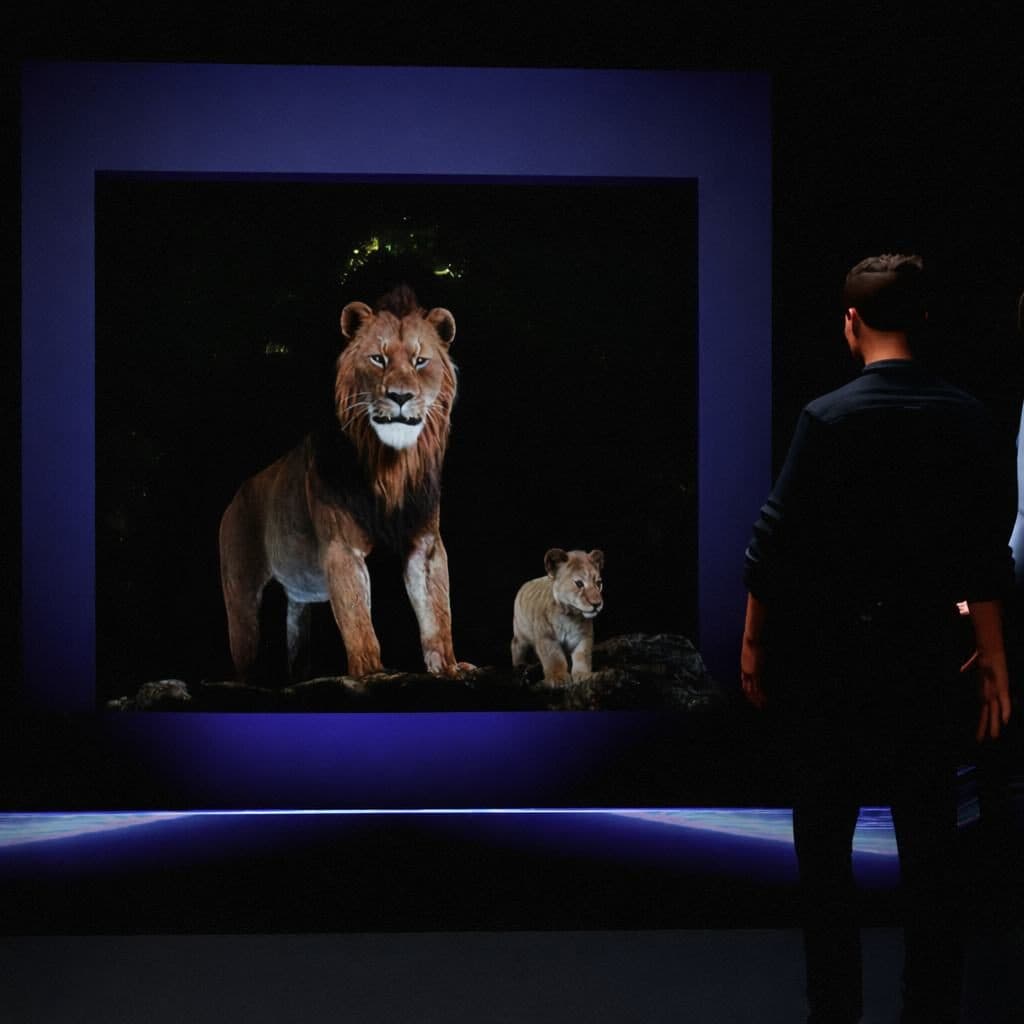
Scope 3 — The Lion Speaks: 3D hologram stage
Duration: 5 minutes
The most memorable idea in the centre, and the one visitors describe afterwards: the lion itself addresses the audience and telling the story about what kind of impact they are experiencing by interference of human being while entering into their territory
What was delivered:
- A complete 3D model of the Asiatic lion, built from the ground up — anatomy, mane structure, coat detail and proportions specific to the Gir subspecies rather than its African cousin.
- Character animation covering movement, gesture and speech performance, timed to a scripted five-minute address.
- Holographic stage installation, engineered for correct viewing angles, ambient light control and audience sightlines.
Why it works: Conservation messaging delivered as instruction rarely lands. Delivered by the animal in question, in first person, it becomes memorable — particularly for children, who form the majority of school-group footfall.
Scope 4 — Interactive touch kiosk
A self-service reference point for visitors who want detail beyond the headline experiences.
What was delivered:
- Interactive touch kiosk hardware, supplied, installed and commissioned.
- Full content creation for the kiosk — the information architecture, written material and visual assets, all developed in-house rather than adapted from existing sources. It’s application where visitor will get to test their knowledge after seeing all the experience and get a digital certificate by giving the right answers.
Why it works: Not every visitor wants the same depth. The kiosk absorbs the questions that the timed experiences cannot answer, letting the main attractions stay tight and cinematic.
The engineering behind it
The visible output is content. The work underneath it is systems integration.
Field acquisition. Multiple 360-degree drone deployments across a protected forest, sequenced across an entire seasonal cycle. Every shoot required coordination with site conditions and access constraints, and none of it could be re-shot on a convenient date.
Content production. Story development, 360-degree post-production and stitching, 3D character modelling, rigging and animation, hologram-ready rendering, and kiosk content authoring — four different production pipelines feeding four different display technologies.
Hardware and installation. Projection systems, a 98-inch interactive panel, Microsoft Surface computing, a holographic stage assembly and kiosk hardware — supplied, installed, tested and commissioned as working systems in a live public venue.
Commissioning. Calibration, integration testing and handover of a facility built to run unattended, all day, in front of the public.
Outcome
All four scopes of work were designed, developed and delivered by Futurotec Solutions Pvt. Ltd. and completed by 30 March 2024, confirmed as successfully executed with satisfactory outcome.
As a standing educational and awareness facility, the centre continues to serve every visitor, student group and school cohort that passes through Ambardi — converting a wildlife outing into an understanding of why the Gir forest, and the last Asiatic lions in the world, are worth protecting.
Capabilities demonstrated
- 360-degree immersive projection design and delivery
- Aerial 360-degree cinematography in protected forest environments
- Long-cycle seasonal content capture
- 3D character modelling and animation
- Holographic display systems
- Large-format interactive touch installations
- Interactive kiosk design and content development
- Narrative and script development for experiential venues
- Interpretation centre concept and experience design (end-to-end authorship)
- Educational and conservation awareness content design
- End-to-end supply, installation, testing and commissioning